
From First Encounters to Deeper Intercultural Learning
Aug 11, 2026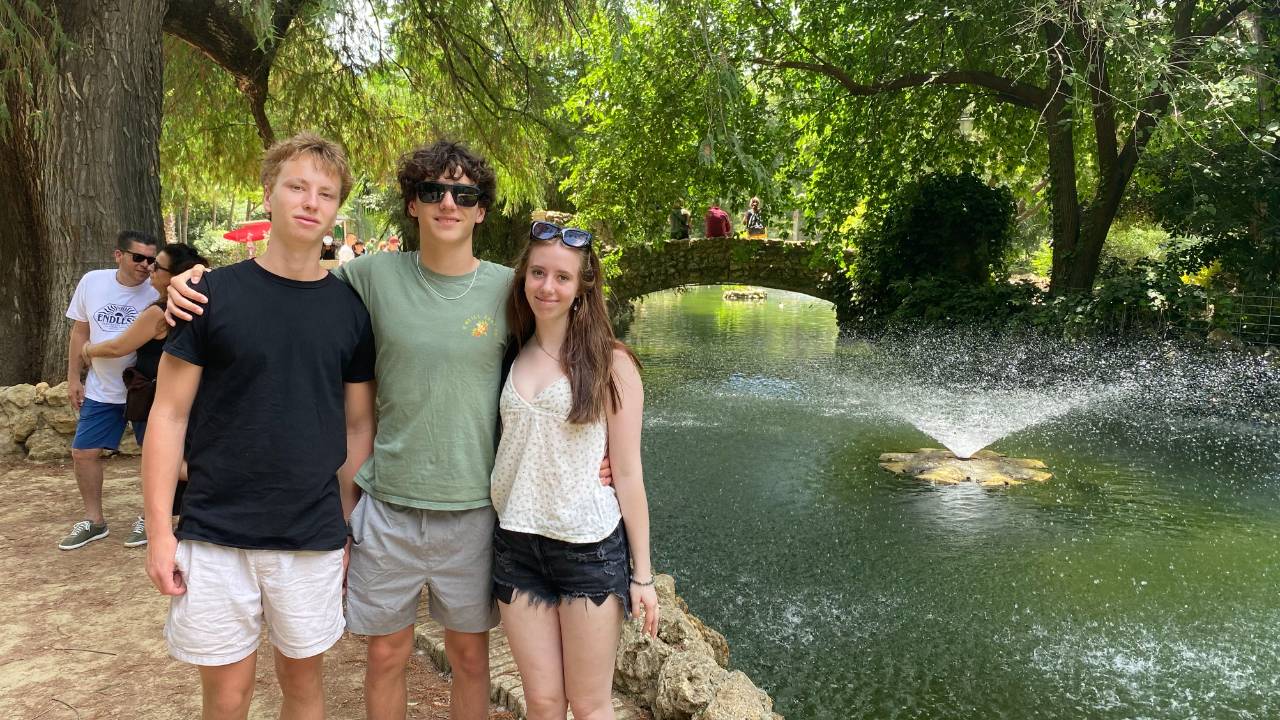
My son (middle) with his friends in Parque María Luisa in Seville, Spain.
Every summer, my family spends time in southern Spain, where my spouse is from. This year, our 17-year-old son brought two friends along for part of our visit. Neither teen had previously traveled outside the United States, although both have been studying Spanish for years.
On paper, for my son’s friends, this was “just” a ten-day trip with family friends. In practice, it gave them a low-stakes but meaningful first experience navigating another language and cultural context. As a result, it was quite impactful. By the end of the trip, they were confidently (if awkwardly) ordering in restaurants for themselves, taking day trips independently, and excitedly making plans to study abroad in the future. One mom commented to me afterward that she was happily surprised by how much her kid had matured as a result.
Their experience reminded me of something I teach often: the importance of balancing challenge and support, while meeting learners where they are. For my son’s friends, the experience presented numerous—yet manageable—challenges. They were using Spanish in everyday situations, reading menus, navigating unfamiliar norms, and depending on others in new ways. At the same time, they were traveling with people they knew and trusted, in a context that made mistakes feel survivable. That combination is crucial. I’ve written previously about the importance of balancing challenge and support during intercultural learning experiences here, and shared personal examples here.
This also connects to a theme that’s come up in several recent conversations I’ve had with colleagues: developing intercultural competence in higher education should not depend on one single experience, such as study abroad. Instead, colleges and universities need to build ecosystems of intercultural learning opportunities—at home as well as abroad—that vary in the degree of challenge they present. Such ecosystems increase access, but they also do something pedagogically important: they give students multiple chances to stretch, reflect, grow, recover, and stretch again.
One way to think about this is not as a hierarchy of “better” and “worse” experiences, but as a sequence of possible learning edges. The right amount of challenge depends on the learner, the context, and the support built around the experience.
A scaffolded intercultural learning ecosystem might include experiences such as the following, loosely organized by the amount of intercultural challenge they may present for many students:
- Low-stakes co-curricular programming that introduces students to cultural perspectives, practices, and questions they may not otherwise encounter;
- Intercultural development intentionally integrated into disciplinary or general education courses;
- COIL projects or virtual exchange embedded into a course;
- Civil discourse or dialogue initiatives;
- Intercultural travel experience embedded into a course;
- Short-term faculty-led study abroad;
- Longer and/or more independent study abroad opportunities;
- Research or internship experiences in other cultures.
Offering various types of opportunities increases the likelihood that students will encounter intercultural learning early and often, with each experience preparing them for another.
I have no doubt that because of their ten-day trip with us to Spain, my son’s friends will seek out additional intercultural learning opportunities. Furthermore, I know they’ll approach their next experience differently than they would have before: with a little more confidence, a little more curiosity, and perhaps a willingness to choose something that stretches them further.
One important reminder, though, is that learning does not come from experience alone. Experience must be transformed into learning through reflection, meaning-making, and guided application. I’ve written more about that here. Intentional facilitation is critical for balancing whatever level of challenge students naturally experience with the support—or additional challenge—necessary to help them make the most of the opportunity.
The larger point is not that every intercultural experience needs to become progressively bigger, longer, or farther away. The point is that students need repeated, intentionally facilitated opportunities to practice intercultural learning at the edge of what they’re ready for. For some, that edge may be a campus dialogue, a COIL project, or a course-based encounter with unfamiliar perspectives. For others, it may be a short-term program abroad, a semester overseas, or an internship in another cultural context. Our responsibility as educators and institutions is to offer diverse opportunities that provide many different pathways, with each new experience successively challenging students further.
Join the Conversation!
Enjoying the blog? You’re invited to join me and an amazing group of higher education professionals committed to fostering intercultural learning at the next Intercultural Leadership Forum! You'll have a chance to connect with others doing this work and gain new insights as you move toward your intercultural goals.
AUTHOR

